
Bulk & Wholesale Jute Bags from India: MOQ, Pricing & Lead Times Explained
Sourcing wholesale jute, cotton, or juco bags from India typically means working with a minimum order quantity per design, a production lead time of several weeks, and a price structure that shifts based on material, branding method, and shipping terms — not a flat per-bag rate you can look up in advance. Here’s what actually goes into each of those, so you know what to expect before requesting a quote.
Minimum Order Quantity (MOQ) — Why It's Set Per Design, Not Per Order
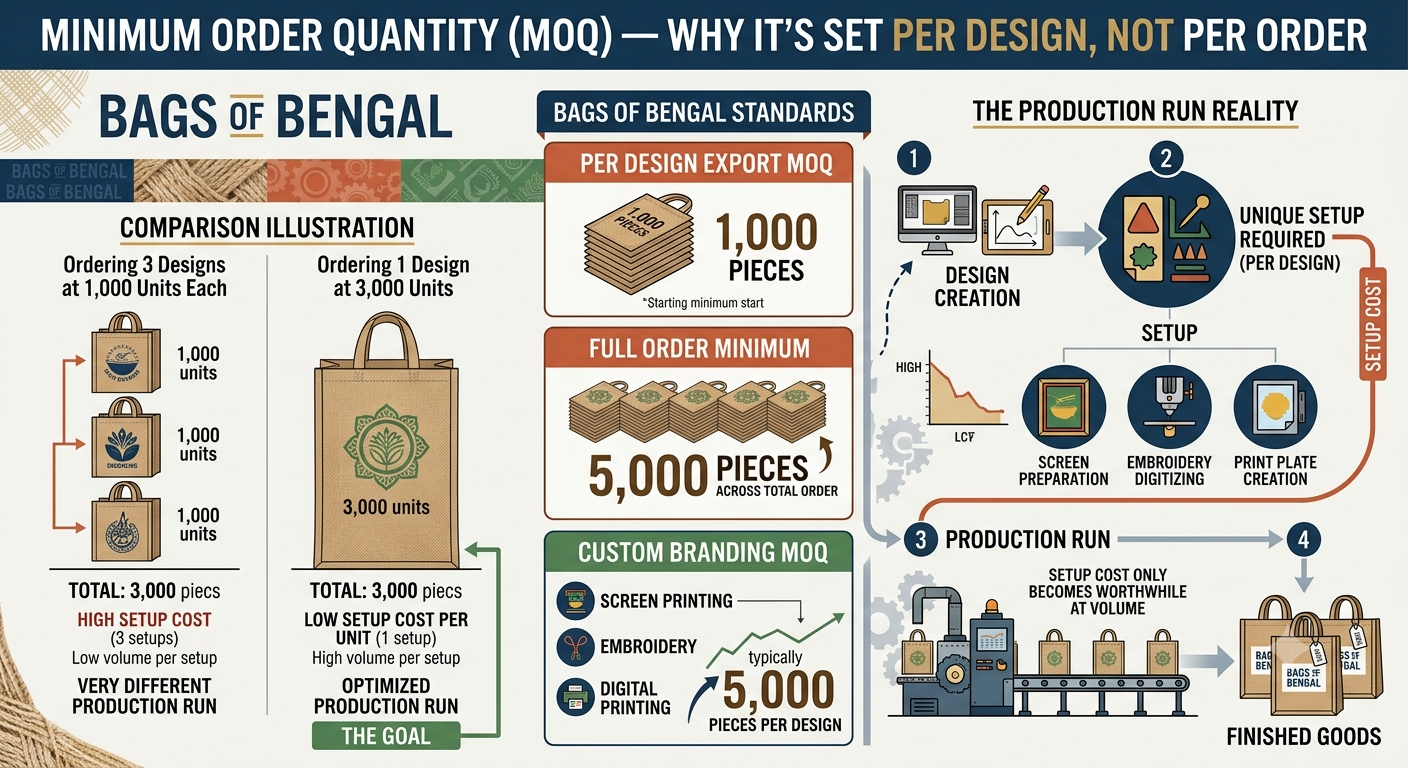
At Bags of Bengal, minimum order quantity for export orders starts at 1,000 pieces per design, with a 5,000-piece minimum across a full order, and custom branding methods (screen printing, embroidery, digital printing) typically carry a similar per-design MOQ of 5,000 pieces. MOQ is set per design rather than per total order because each design requires its own setup — screen preparation, embroidery digitizing, or print plates — and that setup cost only becomes worthwhile at volume. A buyer ordering three designs at 1,000 units each is a very different production run than one design at 3,000 units, even though the total piece count matches.
Production Lead Times
Standard production takes 30-60 days from order confirmation, depending on design complexity, branding method, and current order volume in the factory. Before committing to a bulk order, most buyers request a sample first — sample production and shipping typically takes 7-10 days, which lets you verify material quality, print accuracy, and finishing before the full run begins.
What Actually Drives Pricing
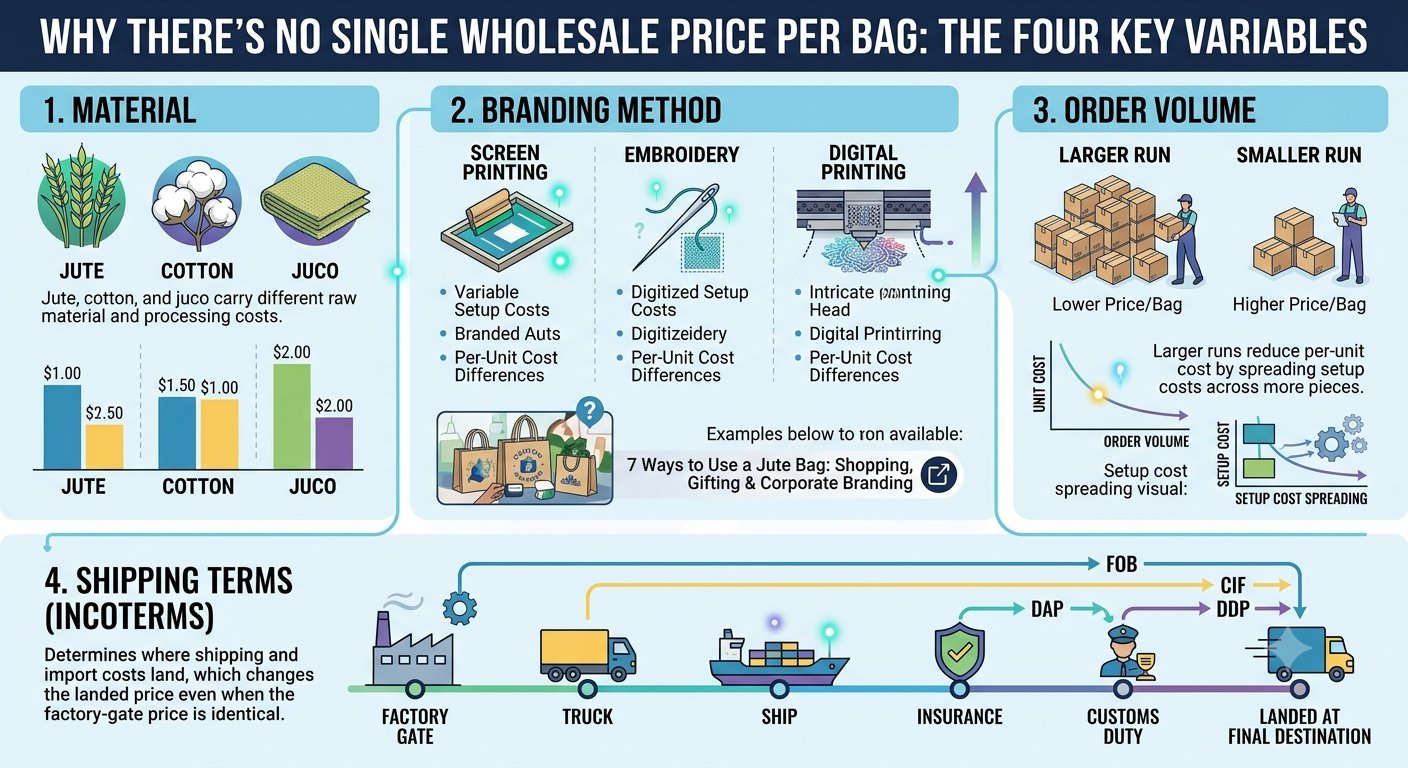
There’s no single wholesale price per bag, because four separate variables change the cost structure on every order:
- Material — jute, cotton, and juco carry different raw material and processing costs
- Branding method — screen printing, embroidery, and digital printing have different setup and per-unit costs. For examples of custom-branded bags in use, see 7 practical ways to use a jute bag – 7 Ways to Use a Jute Bag: Shopping, Gifting & Corporate Branding.
- Order volume — larger runs reduce per-unit cost by spreading setup costs across more pieces
- Shipping terms (Incoterms) — FOB, CIF, DAP, and DDP shift where shipping and import costs land, which changes the landed price even when the factory-gate price is identical
Understanding FOB, CIF, DAP, and DDP
These four Incoterms determine who’s responsible for shipping, insurance, and import duties at each stage:
– FOB (Free on Board) — the manufacturer’s responsibility ends once goods are loaded onto the shipping vessel; the buyer arranges and pays for freight and import from there
– CIF (Cost, Insurance, Freight) — the manufacturer covers shipping and insurance to the destination port, but the buyer handles import clearance and duties
– DAP (Delivered at Place) — the manufacturer delivers to a named location, with the buyer responsible for import duties
– DDP (Delivered Duty Paid) — the manufacturer handles everything, including import duties, delivering to the buyer’s door
Bags of Bengal offers all four terms — which one makes sense depends on whether your business already has an established import/customs process or would rather have that handled for you.
Domestic (India) MOQ Is Lower Than Export MOQ
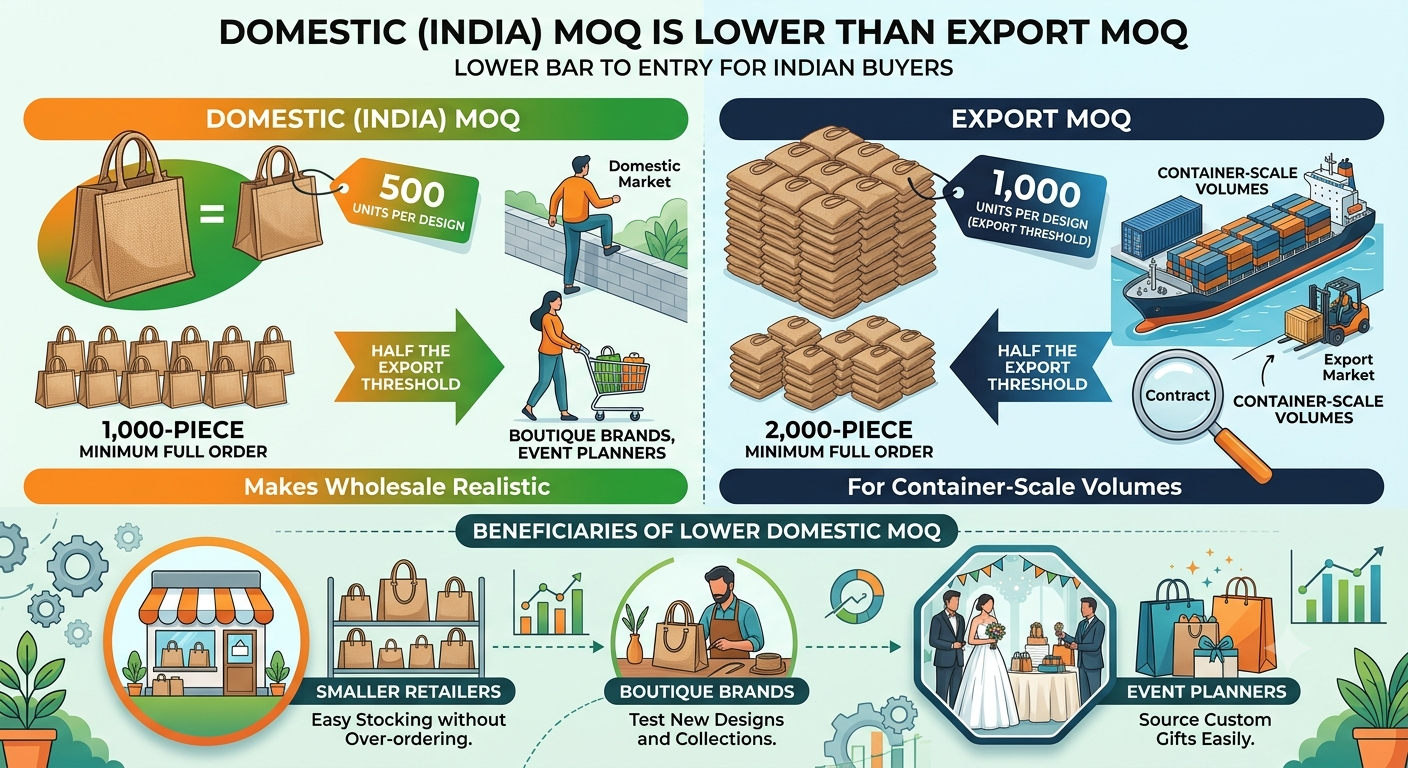
Domestic buyers face a lower bar to entry: orders start from 500 units per design, with a 1,000-piece minimum across a full order — half the export threshold. This makes wholesale ordering realistic for smaller Indian retailers, boutique brands, and event planners who don’t need container-scale volumes.
What to Prepare Before Requesting a Quote
To get an accurate quote quickly, have the following ready: bag style and size, material (jute, cotton, or juco), quantity per design, branding method and artwork, and preferred Incoterm if you already know your shipping preference. Buyers who provide all of this upfront typically get a firm quote within Bags of Bengal’s standard 2-hour response window, rather than a back-and-forth over missing details.
Many export buyers ask for compliance documents alongside a quote. Our guides explain what each one covers:
- SEDEX and SMETA audits – What Is SEDEX Certification? A Buyer’s Guide to Ethically Audited Bags.
- OEKO-TEX chemical-safety certification – What Is OEKO-TEX Certification? A Buyer’s Guide to Chemical-Safe Bags.
- GOTS organic certification – What Is GOTS Certification? A Buyer’s Guide to Organic Cotton Bags.
About Bags of Bengal
Bags of Bengal manufactures jute, cotton, and juco bags from Howrah and Kolkata, West Bengal — see our complete guide to jute bag manufacturing in India for the full picture on certifications, materials, and sourcing, or our FAQ page for more on ordering and export details. Get in touch directly for a quote.
Frequently Asked Questions
What is the minimum order quantity for wholesale jute bags from India?
For export orders, MOQ typically starts at 1,000 pieces per design with a 5,000-piece minimum across a full order. Domestic Indian buyers face a lower threshold, starting at 500 pieces per design with a 1,000-piece total minimum.
How long does it take to produce a bulk jute bag order?
Standard production takes 30-60 days from order confirmation, depending on design complexity and branding method. Sample production, which most buyers request before committing to a bulk order, typically takes 7-10 days.
Why do jute bag manufacturers set MOQ per design instead of per order?
Each design requires its own production setup — screen preparation, embroidery digitizing, or print plates — and that setup cost only becomes economical at a minimum volume per design, regardless of how many total pieces are ordered across multiple designs.
What information do I need to get an accurate wholesale quote?
Bag style, size, material, quantity per design, branding method, and artwork, plus your preferred shipping terms (FOB, CIF, DAP, or DDP) if known. Providing all of this upfront typically speeds up quote turnaround significantly.
What's the difference between FOB, CIF, DAP, and DDP pricing?
These Incoterms determine who handles shipping, insurance, and import duties at each stage — FOB and CIF put more responsibility on the buyer after the goods leave India, while DAP and DDP shift more of that responsibility (including, with DDP, import duties) onto the manufacturer.
Is the MOQ for domestic Indian orders different from export orders?
Yes, domestic orders have a lower MOQ — 500 pieces per design with a 1,000-piece total minimum, compared to 1,000 pieces per design and a 5,000-piece total minimum for export orders.